
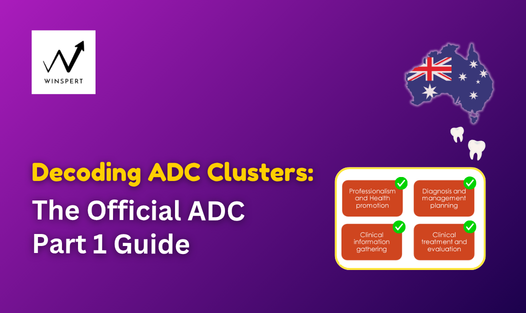
If you’ve started preparing for the ADC Part 1 Written Examination, you’ve almost certainly heard the word “cluster” thrown around by mentors, coaching institutes, and study groups. But there’s a lot of confusion about what an ADC cluster actually is. ADC clusters are an official part of the written exam blueprint, defined in the ADC Written Examination Handbook for General Dentistry and built directly from the Professional Competencies of the Newly Qualified Dental Practitioner.
There are exactly four of them, and you must pass every single one to pass ADC Part 1. This guide explains what the four clusters actually are, how they’re weighted, why passing the exam overall isn’t enough, and how to build a study plan around them.
What Are ADC Clusters, Officially?
The ADC Written Examination Handbook for General Dentistry states that written exam questions are designed to assess specific domains from the Professional Competencies of the Newly Qualified Dental Practitioner, and that these domains are grouped into four clusters. Each cluster represents a category of clinical judgement rather than a dental subject. The exam is built, scored, and passed cluster by cluster which is why understanding the clusters matters as much as knowing your dental content.
The Four Official ADC Written Exam Clusters
The four clusters map directly onto specific domains inside the Professional Competencies document. Three of the four sit within Domain 6, Person-Centred Care, which the Competencies split into three sub-domains: clinical information gathering, diagnosis and management planning, and clinical treatment and evaluation. The fourth cluster combines two separate domains, professionalism and health promotion, into a single cluster.
ADC Cluster 1: Professionalism and Health Promotion
This cluster draws on Domain 1 (Social Responsibility and Professionalism) and Domain 4 (Health Promotion). It tests judgement around ethical and professional conduct, informed and financial consent, culturally safe care for Aboriginal and Torres Strait Islander peoples, recognising your own scope of practice, and applying infection control guidelines and health promotion theory to reduce risk factors and improve oral and general health at a population level.
ADC Cluster 2: Clinical Information Gathering
Built from Domain 6.1, this cluster covers how you collect and record the information needed to understand a patient’s presentation: taking a relevant medical, social, dietary, and oral health history, examining for disease and abnormality, selecting appropriate diagnostic tests and radiographs, and recognising and evaluating a patient’s individual risk factors for oral disease.
Cluster 3: Diagnosis and Management Planning
Built from Domain 6.2, this cluster tests what you do with the information you’ve gathered: reaching a diagnosis, weighing the impact of systemic disease and medications on oral health, deciding when and how to refer, obtaining informed and financial consent for treatment, and formulating a person-centred, evidence-based treatment plan.
Cluster 4: Clinical Treatment and Evaluation
Built from Domain 6.3, this is the largest domain in the Competencies and covers the actual delivery and evaluation of care: applying prevention and early intervention principles, managing dental and medical emergencies, and managing disease across every clinical discipline, including restorative dentistry, endodontics, periodontics, oral surgery, prosthodontics, and pain and anxiety management.
How Much Each Cluster Is Worth
The written exam blueprint assigns each cluster a target percentage of the 280 total questions. Clinical Information Gathering and Diagnosis and Management Planning are the two heaviest clusters, together accounting for 60% of the paper, which reflects how much of the exam is built around interpreting clinical scenarios rather than simply recalling facts.
| Cluster | Competency domain(s) it covers | Sub-weighting | Cluster weighting |
| Cluster 1 | Social Responsibility & Professionalism + Health Promotion | 12% + 8% | 20% |
| Cluster 2 | Clinical Information Gathering | 30% | 30% |
| Cluster 3 | Diagnosis and Management Planning | 30% | 30% |
| Cluster 4 | Clinical Treatment and Evaluation | 20% | 20% |
Within that structure, 240 of the 280 questions are scored and count toward your result; the remaining 40 are unscored trial items spread evenly across all four sections, and you won’t know which is which while sitting the paper.
Why You Must Pass Every Cluster, Not Just the Overall Exam
The ADC does not average your performance across the exam and hand out a single overall grade. It scores each of the four clusters separately, and you’re graded A, B, C, or D in each one. Grades A and B are a pass; Grade A stands for passing beyond 10 percent of the passing mark and B stands for passing within 10 percent of the passing mark. C and D are a fail; C stands for failing within 10 percent from the passing mark whereas D is a clear fail, below ten percent of the passing mark. To pass ADC Part 1, you must achieve a Grade A or B in all four clusters at the same sitting.
The passing standard for each cluster is set using modified Angoff standard-setting methodology combined with Rasch modelling. Cluster pass marks aren’t published and can shift slightly between sittings depending on question difficulty. The practical implication is significant: a candidate who is excellent at clinical treatment and evaluation but weak at diagnosis and management planning cannot rely on one score to compensate for the other. Each cluster has to independently clear the bar in order to clear the overall exam.
Final Words
Understanding the four official ADC clusters changes how you should read your own preparation. It’s not enough to feel broadly ready for ADC Part 1; you need to be confident across all four clusters independently, because that’s how the exam is actually marked. At Winspert, our ADC Part 1 Written Exam Course is built around this exact structure, mapping content, mock exams, and performance tracking to all four clusters so you can see precisely where you stand before exam day, not after it.