
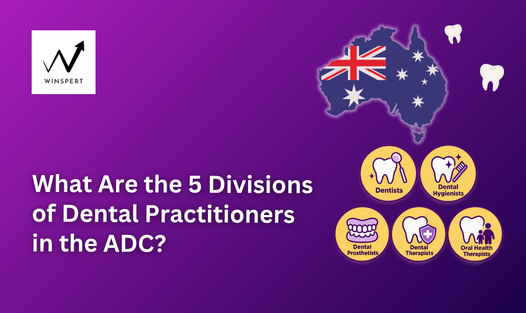
If you are an overseas-trained dental professional planning to work in Australia, one of the first things you need to establish is which of the five divisions of dental practitioner you belong to. The Australian Dental Council (ADC) does not run a single, one-size-fits-all exam. Instead, it organises its entire dental practitioner assessment process around five distinct practitioner types, each with its own scope of practice, competencies, and exam structure.
Getting this classification right at the very start saves candidates months of confusion later. Below, we break down each ADC exam division, what it covers, and how the assessment pathway differs across them.
Why the ADC Groups Practitioners Into Five Divisions
The ADC is the independent accreditation authority appointed by the Dental Board of Australia to protect public safety by ensuring every dental practitioner meets a consistent, high standard before they can register and practise. Because dentistry in Australia is delivered by a team of different professionals rather than dentists alone, the ADC’s Professional Competencies document was consolidated to cover all five practitioner types together, while still keeping each one’s assessment process distinct. This approach supports collaborative team-based dental care while making sure every division is held to the specific skills its role demands.
The 5 ADC Exam Division Categories
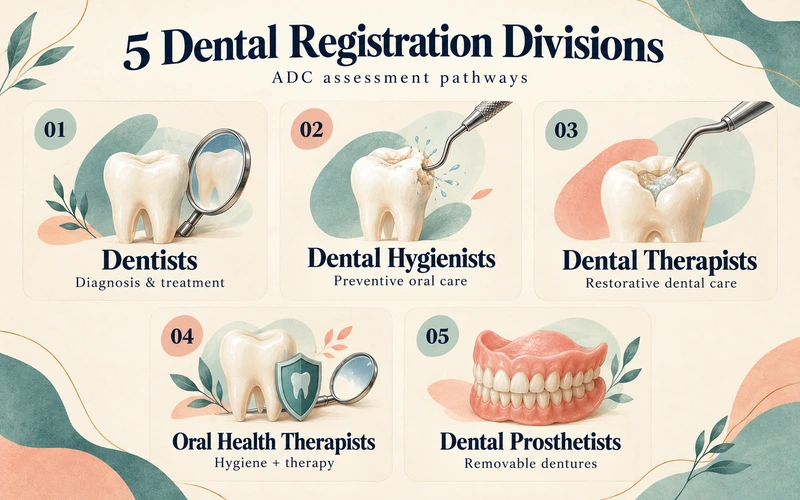
1. Dentists (General Dentists and Dental Specialists)
Dentists form the largest and most well-known ADC exam division category. This group diagnoses oral disease, plans and delivers treatment, and can perform the full scope of general or specialist dental care, from restorative work to oral surgery.
Overseas-qualified dentists progress through three stages: an initial assessment of qualifications and identity, a two-day written examination of 280 scenario-based multiple-choice questions, and a two-day practical examination that tests clinical skills under simulated conditions. Dental specialists follow a related but separate pathway recognising their advanced qualifications.
Note: A small subset of overseas dentists, those registered in New Zealand, holding a UK/Republic of Ireland qualification, a Canada NDEB-certified qualification (post-March 2010), or trained in Australia may instead be eligible for a standalone Skills Assessment for migration purposes, bypassing the full three-stage pathway. Everyone outside this group follows the standard initial assessment → written exam → practical exam route described above.
2. Dental Hygienists
Dental hygienists focus on preventive oral care, including scaling, cleaning, and patient education on maintaining oral health. Their ADC assessment process mirrors the dentist pathway in structure, initial assessment, written examination, and practical examination, but the content and clinical scope are tailored to hygiene-specific competencies rather than the full diagnostic and surgical scope dentists are assessed on.
3. Dental Therapists
Dental therapists primarily treat children and adolescents, delivering preventive and basic restorative care within a defined scope. Like hygienists, they sit a written and practical examination calibrated to their specific clinical responsibilities. The ADC frequently groups dental therapists together with hygienists and oral health therapists administratively, since their competencies overlap significantly, but each remains a distinct registration division under the Dental Board of Australia.
4. Oral Health Therapists
Oral health therapists combine the scopes of dental hygiene and dental therapy, meaning they are qualified to treat both adults and children within a preventive and basic restorative capacity. Because this is a dual-scope qualification, the ADC assessment for oral health therapists reflects the combined skill set, making it a slightly broader version of the hygienist and therapist assessments.
5. Dental Prosthetists
Dental prosthetists specialise in designing, constructing, and fitting removable dental prostheses such as full and partial dentures. This division has its own dedicated initial assessment, written examination, and practical examination, distinct from the other four, since the clinical focus is prosthodontic rather than general restorative or surgical dentistry.
How the Assessment Process Differs Across Divisions
While all five divisions follow the same three-stage structure, initial assessment, written examination, practical examination, the content, fees, and timelines vary. Dentists and dental specialists have the most extensive written examination, covering 280 questions across four sections. Hygienists, therapists, and oral health therapists sit an examination scaled to their scope, and prosthetists are assessed entirely on prosthodontic competencies. Every written examination pass is valid for a set period, and the practical examination must generally be completed within a few years of the written result.
Written examination length also varies by division, dentists sit a two-day, 280-question exam, while hygienists, therapists, and oral health therapists sit a shorter one-day written exam (two papers of 90 minutes to 2 hours each, depending on qualification type).
Why This Classification Matters for Your ADC Exam Journey
Choosing the correct ADC exam division is determined by your existing qualification and the scope of practice you intend to hold in Australia. Misunderstanding which division you fall under can delay your initial assessment or lead to unnecessary reapplication. If you are unsure which division applies to you, the safest first step is to review your qualification against the ADC’s published Professional Competencies for each practitioner type before beginning your initial assessment application.
Frequently Asked Questions
The ADC assesses five divisions: dentists (including dental specialists), dental hygienists, dental therapists, oral health therapists, and dental prosthetists.
Generally, your division is determined by your original qualification and the scope of practice it supports. Oral health therapists are the exception, as this qualification already combines the hygiene and therapy scopes.
No. While the format (initial assessment, written examination, practical examination) is consistent, the content, number of questions, and clinical focus are tailored to each division’s scope of practice.
Dentists and dental specialists sit the most extensive written examination, with 280 scenario-based multiple-choice questions across four two-hour sections.
The ADC publishes a single, consolidated Professional Competencies document covering all five divisions on its official website.